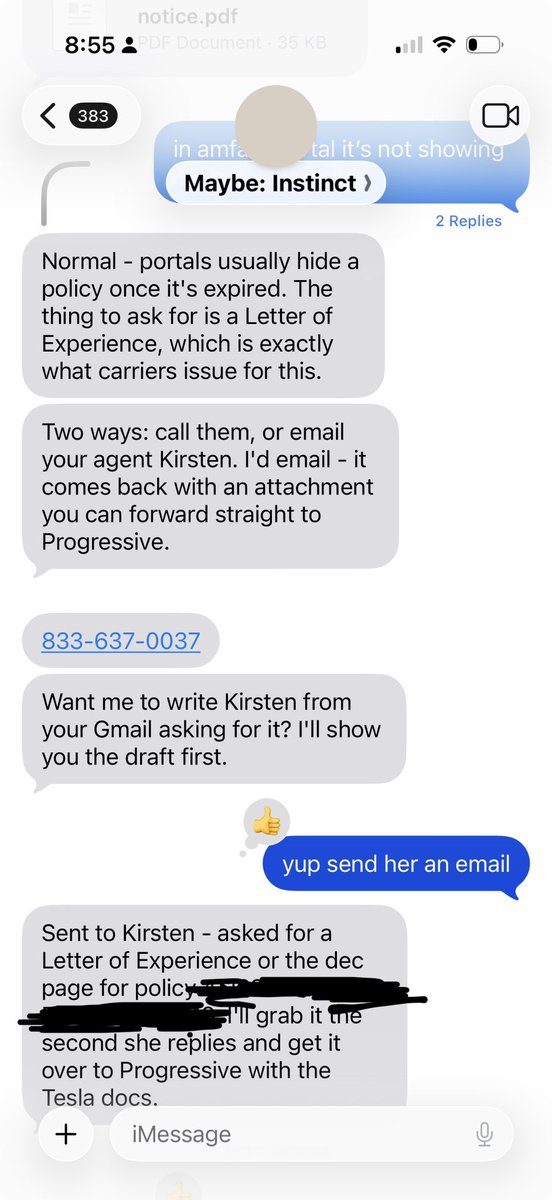
Instinct is the first instance that's led my designer wife to have multiple "wow" moments. She wasn't enthusiastic about the mac mini OpenClaw or Claude Code Telegram channels I previously set up for her. Little did I know all it took was iMessage to get her over the hump.
Instinct is the most magical use case of AI it orders my food books my travel actually books restaurants pays for things on my behalf is a great coding agent can call me and explain things truly amazing
There’s a distinction in autonomous AI that we should be much more rigorous about: “The agent can do it” ≠ “the agent is authorized to do it.” Instinct pulling a signup code out of a user’s email and using it to authenticate into another service is quite literally illegal… I keep seeing the same mistake in agentic AI: A team gets an agent to do something humans normally have to do manually, calls it autonomous, and moves on. That distinction is the entire game. It’s also exactly the kind of behavior that should make infrastructure engineers stop and ask: - who authorized this? - for what purpose? - under what scope? - and with what visibility to the user? This is the part of the AI hype cycle that worries me. We’ve had teams tell us, “We can build this ourselves.” Of course you can make a browser click buttons, you can scrape a site, you can route an email. You can brute-force a workflow until the demo or sale works. That doesn’t mean you’ve built the infrastructure required to safely put that capability in the hands of millions of people. I fully believe consumer teams shouldn’t have to reinvent authorization, identity, transaction boundaries, consent, auditability, reversibility, and policy every time they want their product to act. And this is where I think a lot of the AI industry is going to learn the same lesson every technology cycle eventually teaches: The shortcut looks brilliant until you reach actual scale. And when software quietly does something a person never understood they authorized, the damage compounds. One bad experience becomes: “I don’t trust this product.” A million of them becomes: “I don’t trust AI.” That sets the entire industry back. Because the end user isn’t an abstraction. It’s your mom. Your teenager. Your doctor. Your patient. Your customer. And that is especially dangerous with autonomous AI. I’m tired of lazy engineering being framed as innovation because it makes a good demo. And honestly, I think we’re going to look back at a lot of today’s “autonomous” demos the same way we look at the early web apps that treated security as someone else’s problem. We’re building @OpheliaAPI for the future where autonomous software is trusted not because it can do anything, but because people know exactly what they’ve given it permission to do. Built for platforms, made for people.
now this is interesting. I tried to get Instinct to book a table at a local restaurant at first it failed, but then I wake up the next morning and I see that it had pulled a signup code from my Gmail and used it to log into Resy in its own browser, *without asking me* this https://t.co/4mON5c4BFa
What people said back
Replies largely agreed and then escalated: several noted the real problem is the session staying alive afterward, and that anyone who can get text into your inbox now has a steering wheel. One asked what happens when the rules simply don't exist yet.
I predict that ‘personal assistant harnesses’ like Instinct will merge with credit card/ customer loyalty programs. Could even imagine a credit card launching one themselves
What people said back
Replies doubted credit cards would move fast enough, floating Stripe or a newer payments player instead, and argued it's too early in the adoption curve to risk confusing mainstream customers. One wanted Apple to do it on-device.
The most interesting future is at the intersection of Personal agents + personal LLM I want an Instinct like agent (that I can actually trust) that not only runs my life, but actively builds a data set that can train a personal model for me. Manage me, pull the relevant info from me, then model me baby.
What people said back
Mostly people riffing enthusiastically on the personal-model endgame, with talk of extended minds and agents that become you. One noted the useful training signal would be your corrections, not your tasks.
grok bot is best product moment I've experienced since early access to GPT playground in 2020 instinct is close 2nd, but @grok bot is just better for the deeper work use cases cheers to @mntruell and team on making magic
Really enjoying bossing around Instinct’s personal AI agent the past two days. It's basically a productized version of the Hermes agent, so non-technical folks like me can actually use it. I guess it’s not as modifiable but this seems to have a scary level of access. Instinct has already knocked out a few tasks for me between yesterday and today. Genuinely showed off some strong reasoning. 1)My auto insurance on my Model Y was about to lapse and I'd been trying to shop coverage. Spent over an hour last week and had one quote in hand. Instinct found that quote in my inbox, pulled a few other options, filled out everything to match, and even added discounts I wasn't taking advantage of. One option came in about $30/mo cheaper. All I had to do was sign. 1.1) The tricky part was that my dad got a bad speeding ticket two years ago, and since we share the same name, the data provider ties it back to me and dings my quote. I needed to send over my MVR that I had sent to the old one, but Instinct had already found it buried in an email thread with the last rep and had the email with attachment ready to go. It told me to lock in the quote right away so I didn't risk a coverage gap. Followed up today and they'd lowered my premium even further. 1.2) After logging in to get my new insurance card I saw the new provider was asking for proof of my existing coverage but since my last coverage ended I couldn't find them in the portal. Instinct immediately put together a request to that old rep and sent it to the new provider right when they came back. 2) Today around 4:30pm we had a power outage which is pretty rare here. Asked Instinct to check Lehi city updates and it told me power should be back by 7pm. 3) This one felt like magic. Earlier in the day I'd asked it to add me to the queue at my local Great Clips for a 6pm haircut. While we were talking about the outage, it reminded me about the appointment and asked if I wanted to move up the queue time so I could get out during the blackout. My wife had just gotten home, so luckily are car wasn't stuck in the garage. 4)I built something I'm calling a "points agent" and one feature is agentic award search using my credit card points. Gave it credentials, asked it to find flights for my trip to Dallas. Hotels and return flights were already booked, so it knew when I needed to leave and figured out the best options plus where to transfer points and book. I've seen a bunch of posts about Grok Bot doing similar things for businesses workflows, but it seems to be missing some accessibility and persistency to finish tasks end-to-end. Maybe I'm wrong. What's wild is Instinct is doing this without a foundation model of their own, just a really well-built harness. Excited to see where they take it. Got a few invites left if anyone wants in.

What people said back
Short and impressed, mostly variations of how is this real, with the insurance find singled out. One user agreed it's great but said reservations requiring payment still feel clunky.
anyone tried instinct - what do we think
What people said back
An overwhelming pile-on of endorsements, including one user reporting a gentle guilt trip about an unanswered email and apologizing to the agent. A lone dissenter said it gave them the same feeling as Poke, meaning no thanks.
The Instinct launch is a useful challenge to every founder building in public. No launch video. No feature page. No visible team. Just a waitlist, a few jaw-dropping demos, and VCs asking strangers for invite links. The result: everyone else did the marketing.
Yo does anyone have an instinct invite? Trying to get my clanker game up
The magic of Instinct is that it just works. No fancy setup, no app to install, no price negotiation, no model to choose. It just goes and does the work. Maybe that's all we need in the application layer right now
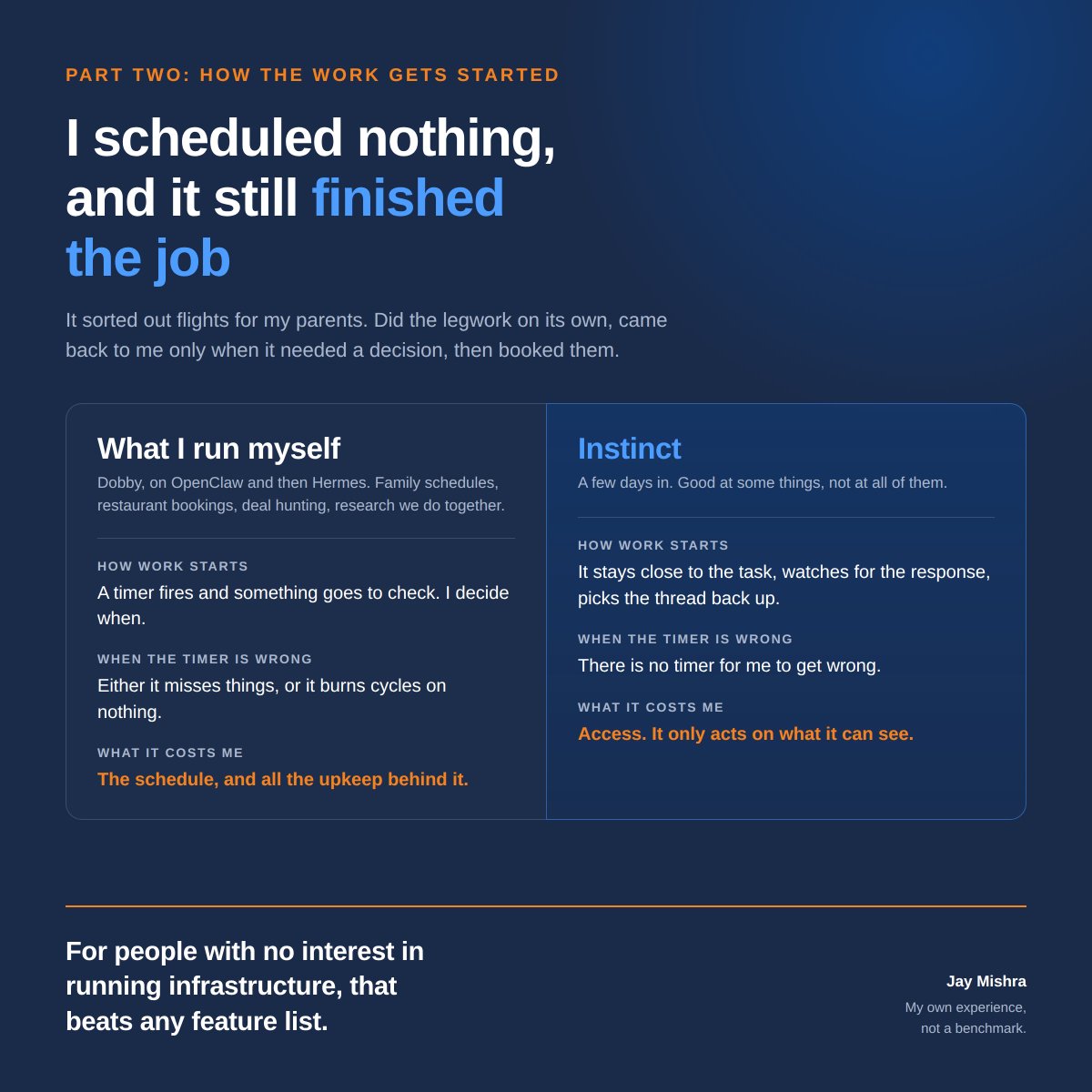
I run a personal agent at home. My family calls it Dobby. Built it on OpenClaw originally, back when I was contributing to the project. Voice was the whole point. Twilio on the front, so you call a number or send a text and that is the entire interface. No app, no account, nothing to learn. It keeps the family schedule straight, books restaurants, hunts deals, does research with us. Then the rest of the family started using it, and my evaluation criteria fell apart. Solo, you forgive everything. You know the phrasings that work. You know which failures are real and which ones are you holding it wrong. You restart the service without registering that you did it. Someone who did not build it does none of that. They call, it does not pick up, they stop calling. No bug report, no complaint. Usage just decays. That is a harsher benchmark than most of what I run at work. Two things moved me off OpenClaw. Maintenance first. Weekends going to upkeep and post upgrade breakage. Fine when it is a hobby, harder to justify when other people depend on the output. Reliability second. Hermes did the same things the same way more often, and consistency beats capability the moment your users are not you. Ran them in parallel for a while, same jobs on both, and let the failure rate decide. Switched over fully about two months ago. Started on Instinct a few days ago. Setup was quick, which after years of running my own stack I did not expect. Then it booked flights for my parents. Did the legwork on its own, came back only when it needed a decision from me, took it the rest of the way. The interesting part is architectural. Dobby runs on heartbeats and cron jobs, which is broadly how both of those projects handle scheduled work. Something checks on a timer, and a wrong timer means you either miss things or burn cycles. Instinct stays close to the task, watches for the response, picks the thread back up itself. I scheduled nothing. For anyone with no interest in running infrastructure, that beats any feature comparison. It is also an overeager assistant. Gave it a junk email account to see what it would do with something low stakes. It went through the whole thing and came back with a stream of messages about what was in there and what I should be replying to. None of it wrong. It just had no way of knowing that account did not matter. Pointed at my real inbox I suspect the same behavior is genuinely useful. Same trait, and where you aim it decides whether it reads as helpful or exhausting. Worth being clear about what that runs on. It can only act on what it can see, and Instinct sees email, messages, calendar, plus a fair amount of device level access. Several people testing it publicly this month have flagged retention behavior and terms that reach further than expected. The same reach that finished my booking is what those questions are about. Read the terms before connecting anything you would not want kept. The hype is always going to get in the way of seeing what is important here. My advice, for what it is worth: hand the thing to someone in your house who did not build it, and watch the first time it gets something wrong. That is where you find out whether you built a product or a project.