How could we massively boost productivity in health & care? Part two.
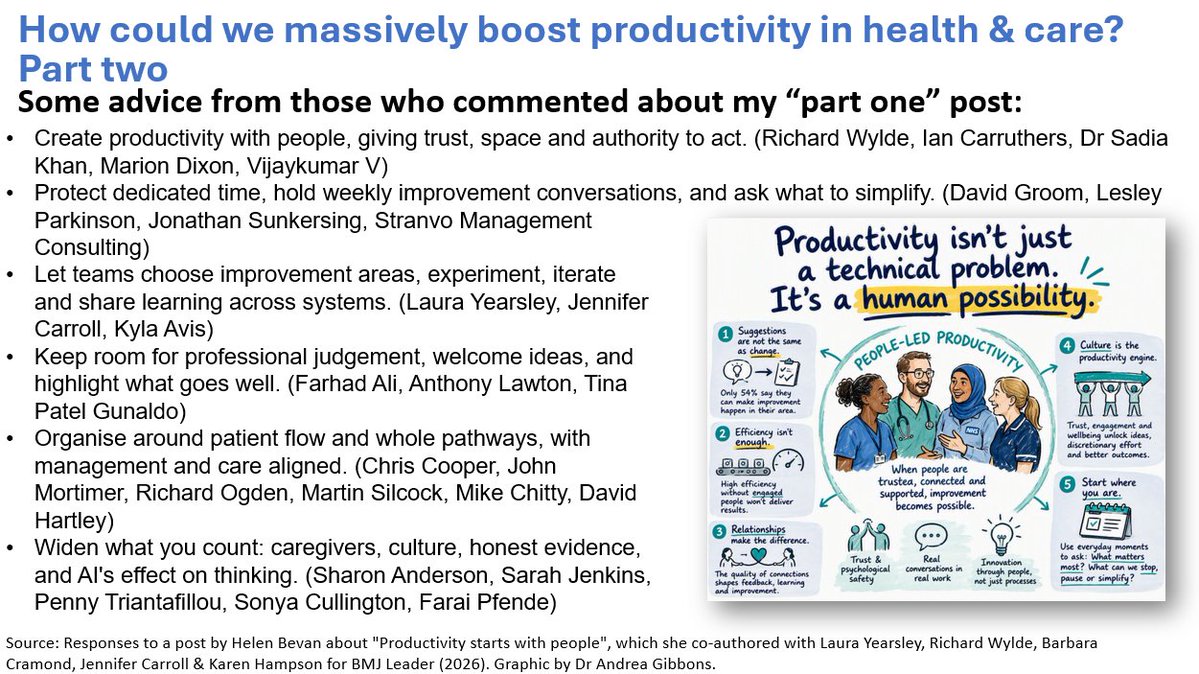
A summary of comments on my last post about "Productivity starts with people", co-authored for @BMJLeader. These come from across multiple social platforms. Five themes stood out:
1. Who creates productivity? Richard Wylde argued productivity cannot be done to people. Those closest to the work see the opportunities and barriers most clearly, given trust, support and space. Ian Carruthers said the NHS needs to give people permission and authority to fix obvious problems. Marion Dixon asserted that good leadership which supports staff to “change their world” really matters. Dr Sadia Khan contrasted “control” that yields compliance, and “psychological safety and agency” that yield innovation. Laura Yearsley described people choosing the improvement areas themselves, with learning as the strategy in place of a detailed plan, with people from surgeons to nursing assistants choosing to make time for the work within demanding jobs.
2. Permission, time and support: David Groom noted change cannot sit on top of the day job. People want to be productive and need permission, structure, time and senior support. Jonathan Sunkersing observed progress comes from modest improvements done consistently, which makes it accessible to everyone. As a leader, Lesley Parkinson would agree the improvement gap with the team and hold those conversations weekly. Anthony Lawton recalled a manager complaining he produced ten ideas a week, and a finance director who asked how many were good.
3. The conditions for professional judgement: @farhadali said that protocols and prescribed ways of working protect safety; leaving no room for judgement kills the capability productivity depends on. Sarah Jenkins reported the instinct was to hand “productivity” work to finance colleagues, when culture and psychological safety affect us all. Vijaykumar V said without trust and relationship we can do nothing. Jennifer Carroll described creating the conditions for people to do their best work and connect authentically.
4. Shift from managing queues and capacity crises to designing for timely movement of patients, information and decisions: Chris Cooper argued for adopting economies of flow and features of the on-demand economy. Mike Chitty wants managerialism and care to become more comfortable partners. Richard Ogden would concentrate on the bottleneck. Martin Silcock asked who looks strategically at pathways. John Mortimer found the professional taking the call and visiting the person used 14% fewer resources with better outcomes.
5. Who and what we count: Sharon Anderson pointed to family caregivers as a second workforce, invisible in planning and productivity measures, creating hidden work on both sides. Tina Patel Gunaldo wants the same emphasis on what is going well as on what needs improving. Sonya Cullington said sustained AI use can erode the cognitive conditions improvement needs. Farai Pfende cautioned that extra effort and workarounds can make a struggling system look productive.
Thanks to all who commented.
What people said back
Health and care folks piled on about invisible work carried by caregivers and frontline staff, with one noting organizations always add to roles and never subtract. Another pushed for focusing on outcomes rather than counting patients like tins of beans.